

SpO Unplugged: Ljubljana on flash floods, parking, and getting people out of their cars
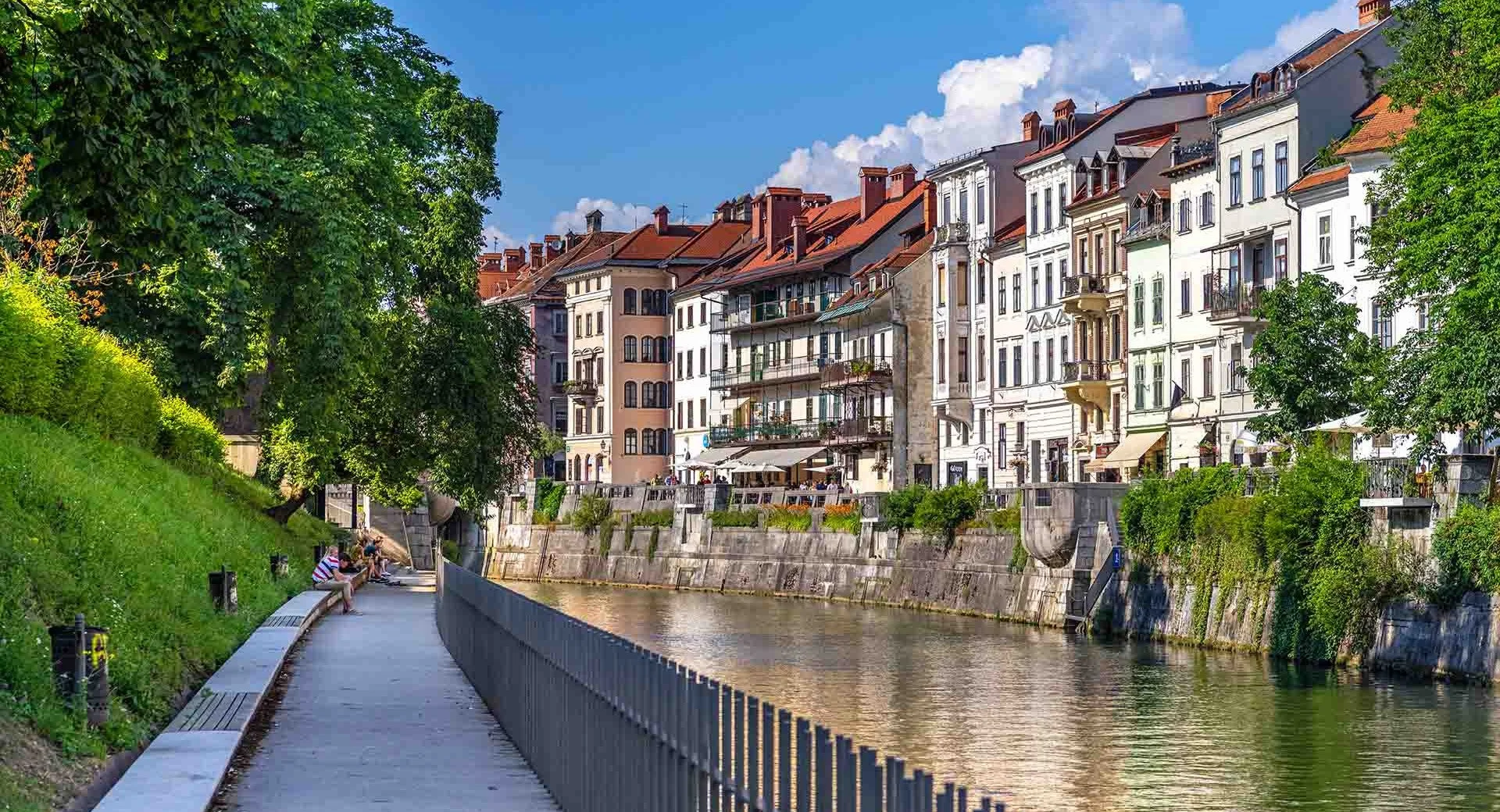
As part of Străzi pentru Oameni's Unplugged series, where we look at examples of good practices from cities across Europe, we spoke with Mirko Krsmanović, who works in Ljubljana's Sustainable mobility and public section of the Department for Commercial activities and traffic.
Our conversation explored how the Slovenian capital approaches public space, active mobility, parking policy, and working with residents to introduce change. He introduced his role at the city hall, in the sustainable mobility and public space department, where his work covers public spaces, parking policies, sustainable and active mobility. His education covers fields of water science and environmental civil engineering. He is interested in blue and green infrastructure (BGI) projects.
Before diving into mobility, there was another topic we couldn't ignore. The day before our interview, Bucharest had experienced both an extreme heatwave and a violent storm within the span of a few hours, leaving many streets flooded and highlighting once again how vulnerable cities have become to increasingly frequent extreme weather events. Given the timing, we asked Krsmanović how Ljubljana is preparing for these challenges and whether the city's approach to public space also plays a role in managing storm water and climate resilience.
From there, the discussion naturally shifted to sustainable mobility, the city's evolving parking policies, collaboration with NGOs and residents, and what lessons a larger city like Bucharest could draw from Ljubljana's experience.
The city already uses monitoring systems to identify flooding areas and hot spots in the city, and has compiled a map of those spots. "In Ljubljana, the weather is getting more extreme," he said. "This means that when you have a storm, it's longer, and a lot of storm water is coming in." He pointed out that Ljubljana is a very green city, close to the point of being what he called "a 15-minute city," because forests and green areas are close by in every direction and already absorb a large amount of water. Even so, some areas are struggling, particularly roads passing under the railway, where a lot of water runs down from the hills.
He acknowledged the city is not yet where it needs to be on this front, though it is working on it. “The city needs to pay more attention to the field of extreme storm waters and surface runoff”. As an example, he mentioned that a skate park or bike park built below street level could have a double use as temporary water storage, holding water for around two hours before it drains away through retention. "You can use it for cycling, you can use it for parks, you can use it for retention of water, and so on." This use of public space is already functionally used in several cities (e.g. in Netherlands)
At the national level, Krsmanović said Slovenia is somewhat behind in some parts of the country, even though a lot of work has been done.
“We have had these plans for 15-20 years, but the actual implementation is still lagging a bit behind. Ljubljana has already built one of the dry water retainers and arranged the riverbeds and streams against flooding, and it will be necessary to complete another dry water retainer that will permanently and efficiently protect Ljubljana from once in 100 years high waters. For the last few years the City of Ljubljana has not been flooded.”
Building a Section for Sustainable Mobility and Public Space
The conversation then turned to the reason for the interview: how Ljubljana is reshaping its streets and public spaces, and how the city works with residents, NGOs, and other departments to make those changes possible.
The sustainable mobility and public space section works closely with the traffic section: "We are working hand in hand, because the subject is complex and covers several areas of transport and economy, so there's a lot of work to be done." In a small town, closing a road might be a simpler task, but in a larger city, when doing a permanent or temporary traffic solution, we must model how traffic redistributes.
"All the traffic will rearrange in the end, but habits will not change immediately. Rearrangement forces people to accept new reality and question their habits: 'Aha, now this is the new way, perhaps I'll start cycling or walking, for example.' It's a process that may also bring some resistance from the population. It's hard for people to change, especially from a comfort zone to some new comfort zone. It is on City administration to provide safe infrastructure for that kind of freedom.”
At the moment, the city is developing a full traffic model covering all of Ljubljana, expected to be finished by March 2027. Once complete, it will show how traffic is generated on every street, making it easier to introduce changes such as more dedicated bus lanes.
Within his own direction, the focus is on promoting active mobility and identifying streets that could be turned over to pedestrians. One current pilot project involves testing a cycling road on one of the city's streets.
Working with NGOs, and a Case That Didn't Go So Well
Asked about cooperation with NGOs, Krsmanović said this happens because municipalities are generally short-staffed.
“We are more oriented to, let's say, the bureaucratic processes for implementation. We need NGOs for studies, pilot programs, or communications with the residents."
Not every project has been a success. Krsmanović pointed to one neighbourhood where plans to reform parking policy met strong resistance despite several rounds of public consultation. Too many cars were parked in public space designed for pedestrians and safe play for children., even though the neighbourhood was already connected by new cycling paths to the city centre and other areas. The city had communicated with residents twice through NGOs and again through the local municipal office, and the mayor had also spoken with journalists on several occasions. Even so, a resistance emerged, not from the whole neighbourhood, but from part of it.
"Even if they don't represent the whole neighbourhood, maybe they represent 5%, they have great momentum and they gathered enough support to trigger a local referendum on the parking policy.”
"I’ve just talked with fellow specialists in sustainable mobility from the Netherlands, and they confirmed that in the small cities they have the same problems as Ljubljana. It's not all Amsterdam or Rotterdam, where there is a successful story of just cycling and public transport."
Even with communication, he estimated around 20% resistance tends to remain, requiring further rounds of engagement. If you reach 80% agreement with a good communication strategy with residents, you are on the exceptional path.
"It's very difficult to change people's attachment to cars. This is a kind of status symbol in Slovenia, as well… In the Balkans, generally, when you have a certain type of car, you succeed. We are all intimately connected to our vehicles and tend to build self-confidence and our own branding as people. It can become an additional family member.”
Competing with emotionally connected comfort is extremely challenging. Car sharing, public transport and active mobility (cycling, walking) are the only solution for cities to start breathing again. The first goal for a modern city is to have 1 or no privately owned vehicle per family. The ideal city has less than 50% of privately owned vehicles. In order to do that, we need to highlight the smart and high-quality regional connection of rural and satellite cities with a larger city with public passenger transport as a necessity.
In the neighbourhoods, the goal is to reduce car use and encourage households to reconsider how many cars they actually need. Krsmanović also drew on his own experience to illustrate the changes the city hopes to encourage:
"We had two cars in our family and we sold one. Sometimes I cycle or use PPT, sometimes my wife does, sometimes we all do. We have children, so we rearranged our family so we can use a car as little as possible: less expenses, less problems with parking."
He cited a worldwide study showing that cars are parked 95% of the time. “More than 60-70% of the time it stays in parking lots in front of our homes. Waste of natural resources, waste of space, waste of our time. A terribly bad investment”
Car sharing is another part of this approach. This year, the city signed a public-private contract with a company already operating locally, adding 400 shared cars along with new parking spaces reserved specifically for car sharing also in the neighbourhoods.
"We are not idyllic.We have 380 kilometres of cycling paths, and 1,600 kilometres of roads. So let's say about one-fourth of the city is covered, but all main traffic flows are fully covered."
Public Space and Parking Policy
Krsmanović described the department's broader goal as returning public space to people, since some public spaces had informally become parking, in some cases illegally. The approach starts with counting how many parking spaces exist in a neighbourhood relative to the number of flats and private garages, to judge whether supply is adequate.
"If the ratio is below 0.8, we need to add some parking spaces because we are in a modern society, and not all people can live with public transport.”
The city's current policy is not to build garages itself within neighbourhoods. Parking is considered a private rather than a public interest.
"We can provide you the land, we can provide you the support from the process to get the building permit, but we are not building or financing garages."
Garages are built in some central places where surface parking has already been cleared on the surface and public space returned to pedestrians, with cycling infrastructure added, making a garage serve a broader public purpose. For example, a main market in the city centre where the city wants to build an underground garage, while also adding refrigerated storage for merchandise beneath the market so that deliveries no longer take place at street level. Ljubljana's mayor supports this approach, though it faces great resistance from residents who argue that the city itself should be providing enough parking spaces and building garages.
For Comparison: Bolzano's Approach to Parking
After the interview, Krsmanović shared material from a comparable case in Bolzano, Italy, sent over by Brunella Francini, who works on the same issue there. Her account describes a similar diagnosis but a more assertive, pricing-led response to reclaiming street space from parked cars.
"Residents have everything, parking spaces, well-maintained bike paths, efficient public transportation, and walking paths, yet they don't use this infrastructure enough. This is too costly for the city. That's why we in Bolzano have decided to actively manage parking by moving parking spaces from the streets underground, implementing real-time monitoring of parking occupancy in the city center, establishing parking regulations, and charging residents for parking permits, among other measures. Let me emphasize: residents would have access to all the infrastructure, but they would use it as conveniently as possible. The city simply cannot afford this," says Brunella Francini from the Italian city of Bolzano.
In outer residential neighbourhoods, the goal is to clear cars off the streets to make room for bike lanes, wider sidewalks, and tree-lined avenues. The city does not fund this itself. Instead, it grants residents a 90-year building right for underground space, for instance beneath a local market, park, or school playground. Residents then form a parking cooperative and finance the construction themselves, with each household buying a bay that becomes legally tied to their apartment. Once the underground garage is built, the municipality removes the parking spaces on the surface above it, so residents get secure, privately owned parking underground while the street itself becomes public space again.
The inner city centre works on a different logic, aimed at keeping commuters and tourists from driving in at all. Public underground garages, for example around Piazza Walther, serve short-term parking for visitors and shoppers, with rates set deliberately high to discourage long stays. On the outskirts, near the Fiera exhibition grounds or transit stations, park-and-ride garages are cheap or free for anyone continuing their trip by bus or bike. Inside the limited traffic zone, surface parking for visitors is practically nonexistent: without a permit or a direct route to an underground garage, cameras issue an automatic fine on entry.
Advice for Scaling Up
Given how Ljubljana is noticeably smaller than Bucharest, we asked whether there was anything from their experience that could work in a larger city.
"What we sometimes don't do enough is co-creation and co-design processes. We did communicate, but we maybe did too little of it. We need to include more people, because I think the most resistance you get is when people feel that they're excluded from decision-making. Whether it is a decision they like or don't like, they just don't want to be excluded."
At the same time, total agreement is never realistic. Smaller concessions can help address remaining concerns: adding a new playground or some new greenery, alongside the main project, or implement ideas that come out of the co-creation process.
The project always needs to be in two phases: We might “take” something, and we give you something back.
Communication, in his view, should not be rushed, but at some point a decision has to be made. That requires political backing from the mayor or local council, and can be framed as a pilot that will be adjusted if it doesn't work. An alternative approach, which he said has also worked, is to keep a temporary change in place for a longer stretch of time, six to eight months, so that people adapt and largely forget the previous arrangement.
He noted that co-creation and co-design are a relatively recent practice, popular for the last five to seven years or so; earlier, decisions were made more from the top down, with the mayor working with the city's chief architect for urbanism, followed by public presentations rather than direct engagement with residents in their own neighbourhoods. He considers the newer approach an improvement, but flagged one risk: introducing this kind of resident engagement too close to the end of a mayor's mandate can allow technical, non-political issues to become politicised.
As the conversation came to a close, Krsmanović returned to a point that had run through the entire discussion. Cities cannot wait until every piece of infrastructure is perfect before encouraging people to change how they travel. Nor can they simply introduce restrictions without offering alternatives. The two have to move forward together.
"You cannot do all the infrastructure and then still allow cars, because the city can't afford that. You have to do it hand in hand."
It is an approach that runs through Ljubljana's work, from redesigning streets and rethinking parking to experimenting with pilot projects and involving residents more closely in decision making. While Krsmanović acknowledged that no city gets everything right, he believes steady, incremental change, supported by communication and political commitment, is what ultimately reshapes how people experience public space.